
Artikel: One More Scientific Milestone. One More Reason I'm Proud of What We Build.
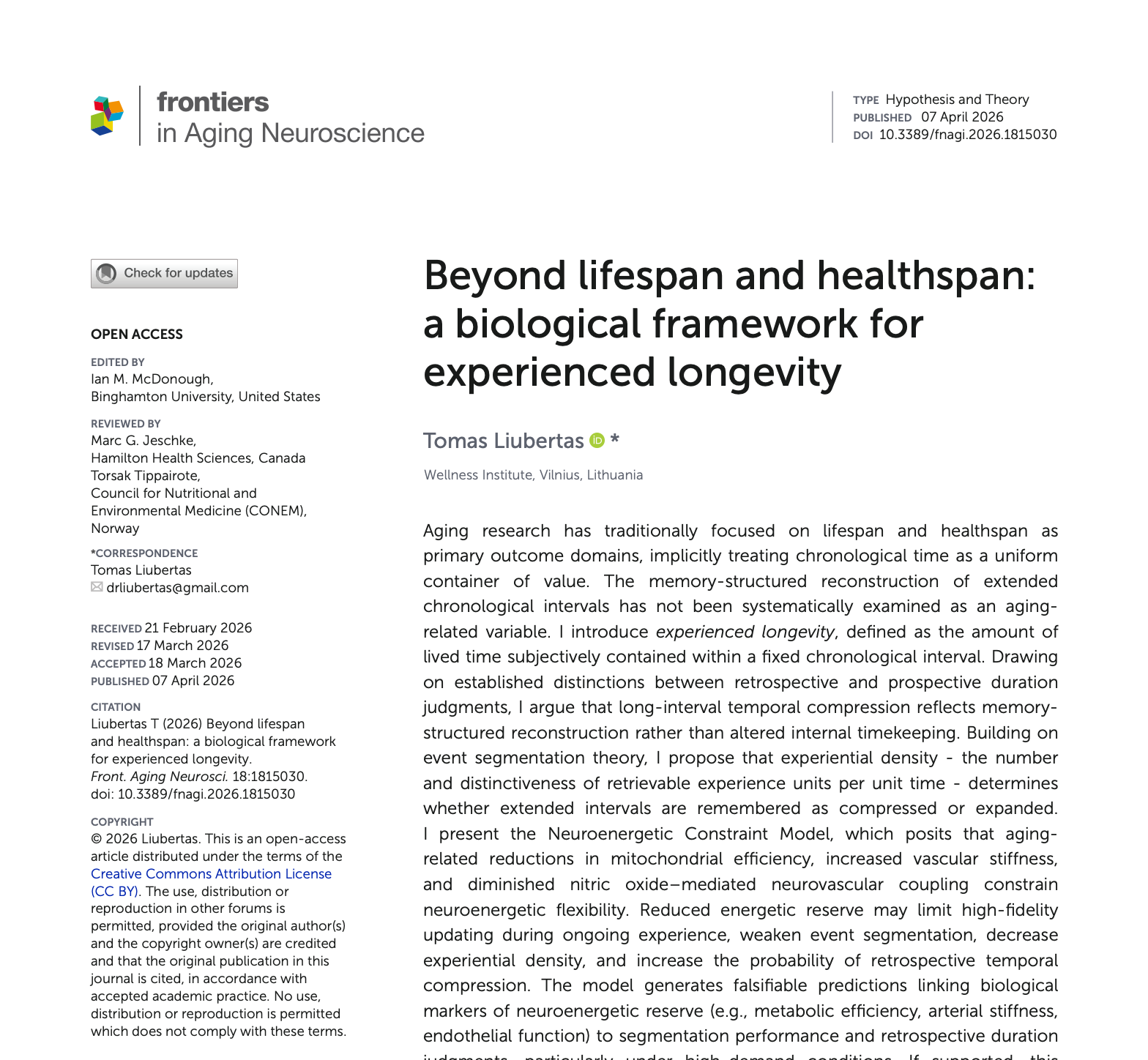
One More Scientific Milestone. One More Reason I'm Proud of What We Build.
Seeing years of curiosity become a peer-reviewed scientific publication is always a special moment. This latest paper reflects the way we think at NOXSHOT: questioning assumptions, exploring new ideas, and letting science lead the way. Research isn't something we occasionally do - it's who we are.
Why Does Time Seem to Speed Up as We Age?
Have you ever noticed that childhood summers felt endless, while today an entire year can seem to disappear almost overnight?
Most of us have experienced this strange phenomenon. We often joke that "time flies," but what if there's more to it than simply getting older?
This question became the starting point for one of my latest scientific publications in Frontiers in Aging Neuroscience. While the article is written for researchers, I wanted to explain its central idea in a way that anyone can understand.
We Usually Measure Aging the Wrong Way
When we think about aging, we tend to focus on two things:
- Lifespan – How many years do we live?
- Healthspan – How many of those years are spent in good health?
Both are incredibly important.
But what if there is a third dimension of aging that we've largely overlooked?
I call it Experienced Longevity.
Imagine two people who both live to be 80 years old. Both remain relatively healthy throughout their lives. On paper, they appear almost identical.
Yet one person feels as though life has been rich, full, and deeply experienced. The other wonders where the decades went.
What creates that difference?
Is Time Really Moving Faster?
Of course not.
Time itself never changes.
Instead, it's our perception of time that changes.
For years, psychologists have explained this through memory. Children constantly encounter new experiences, creating countless vivid memories. As adults, our routines become more predictable, and fewer unique moments stand out. Looking back, those years feel compressed.
This explanation makes sense—but I began wondering whether biology might also play an important role.
Could Brain Energy Be Part of the Answer?
Our brains are extraordinary organs, but they are also incredibly demanding. Although they make up only about 2% of our body weight, they consume roughly 20% of our body's energy.
Every thought, memory, conversation, decision, and emotion depends on a continuous supply of oxygen and nutrients delivered through an intricate network of blood vessels.
As we age, that system gradually changes.
Blood vessels become less flexible.
The communication between blood vessels and nerve cells becomes less efficient.
Mitochondria—the tiny structures that produce energy inside our cells—may also lose some efficiency.
None of these changes happen overnight.
But together, they may reduce what I describe as the brain's energetic reserve: its ability to rapidly deliver and use energy when we need it most.
Why Would This Affect Time?
Our brains don't record life like a video camera.
Instead, they break our experiences into meaningful events.
Meeting someone new.
Watching your child take their first steps.
Standing on a mountain you've never climbed before.
Learning a new skill.
Each of these experiences becomes a distinct chapter in our memory.
The richer and more detailed these "chapters" are, the fuller our lives feel when we look back.
My paper proposes that if the brain gradually has less energetic reserve available, it may encode fewer of these rich experiences.
The result?
Weeks begin blending together.
Months become difficult to distinguish.
Years seem to pass more quickly.
Importantly, this is not because time changes—but because the brain may be creating fewer memorable moments from which our sense of time is constructed.
A New Way to Think About Healthy Aging
If this hypothesis proves correct, it may change how we think about aging itself.
Perhaps successful aging isn't only about adding years to life.
Perhaps it is also about preserving our ability to fully experience those years.
That idea has important implications for neuroscience, psychology, vascular biology, and healthy aging research.
It also highlights how closely connected brain health, blood flow, metabolism, and cognition truly are.
Science Begins With Questions
It is important to emphasize that this publication is a Hypothesis & Theory article.
It does not claim to have solved the mystery.
Instead, it proposes a new scientific framework that can now be tested by researchers around the world.
Every major scientific advance begins with a question worth asking.
My hope is that this work encourages further research into one of the most fascinating aspects of human aging—not simply how long we live, but how deeply we experience the lives we are given.
Because perhaps the greatest measure of longevity isn't only the number of birthdays we celebrate.
Perhaps it's how much life we truly experience between them.
Reference
Liubertas T. (2026). Experienced longevity: the neuroenergetic constraint model of subjective acceleration of time with aging. Frontiers in Aging Neuroscience. https://doi.org/10.3389/fnagi.2026.1815030

